
Architectural Studies
Learn to create spaces of significance, build responsibly, and visualize the future.
Our program’s approach is built upon several historical firsts, from being a pioneer in 1974 in using computer technology in creating art and design (what’s now known as Design with Digital Media), to being one of the first group of eleven programs in the World in 2022 to be awarded Zero Energy Design Designation (ZEDD) by the U.S. Department of Energy. That long history of being educational trailblazers continues through to today, with us being at the forefront of teaching sustainability, design thinking, and advanced computing.
Here you’ll gain the interdisciplinary knowledge and skills to be technical and creative through a hybrid education of architecture AND interior design – enabling you to gain a greater understanding of the holistic experiences of the built environment, along with learning more about materials, finishes, lighting, and human-centered design than you would at most architectural programs.
This provides you with the knowledge, skills, and versatility to make a more meaningful impact on your future professional or academic teams, and influence the wellbeing of the people who live, work in, and use spaces around the world.
Design is not just about creating beautiful spaces; it’s about crafting environments that evoke emotion, inspire creativity, and improve lives. In our department, we don’t just study architecture; we shape the future.

Retention Rate
88.9% of students admitted in the fall of 2023 returned in the fall of 2024.
Graduation Rate
70% of students admitted in the fall of 2019, graduating the spring of 2024.
Job Placement Rate
100% of students graduating in 2024 have a job in the industry or are pursuing an advanced degree.
Degrees Awarded
27 students received a degree with emphasis in Architectural Studies in 2023-2024.
Accreditation
In the United States, most registration boards require a degree from an accredited professional degree program as a prerequisite for licensure. The National Architectural Accrediting Board (NAAB), which is the sole agency authorized to accredit professional degree programs in architecture offered by institutions with U.S. regional accreditation, recognizes three types of degrees: the Bachelor of Architecture, the Master of Architecture, and the Doctor of Architecture. A program may be granted an eight-year term, an eight-year term with conditions, or a three-year term of initial accreditation, depending on the extent of its conformance with established education standards. Doctor of Architecture and Master of Architecture degree programs may require a non-accredited undergraduate degree in architecture for admission. However, the non-accredited degree is not, by itself, recognized as an accredited degree.
Access to NAAB Conditions and Procedures The program must make the following documents available to all students, faculty, and the public, via the program’s website:
- Conditions for Accreditation, 2020 Edition
- Conditions for Accreditation in effect at the time of the last visit (2009 or 2014, depending on the date of the last visit)
- Procedures for Accreditation, 2020 Edition
- Procedures for Accreditation in effect at the time of the last visit (2012 or 2015, depending on the date of the last visit)
Curriculum
Application
Phase I
Building awareness
Students begin by learning abstraction, composition, and vocabulary. This approach exposes students to the basics of design thinking, history, and theory.
Following the 1st year, students must submit a portfolio of their work to continue into the professional phase of the program.
Students are becoming aware of:
- Ideation
- Inspiration
- Technical drawing
- Craftsmanship
- Story telling

Exploration
Phase II
Understanding realities
Students begin applying their developed skills and knowledge to real world conditions. Along with team members, they learn the working processes of defining scope, evidence-based design, and schematic design. This approach exposes students to the basics of professional practice, providing them with the time and knowledge to learn what they’re interested in and experiment before choosing a focus.
Students are exploring:
- Collaborating with team members
- Problem seeking
- Working with project constraints
- Prototyping
- Implementation

Focus
Phase III
Applying knowledge & skills
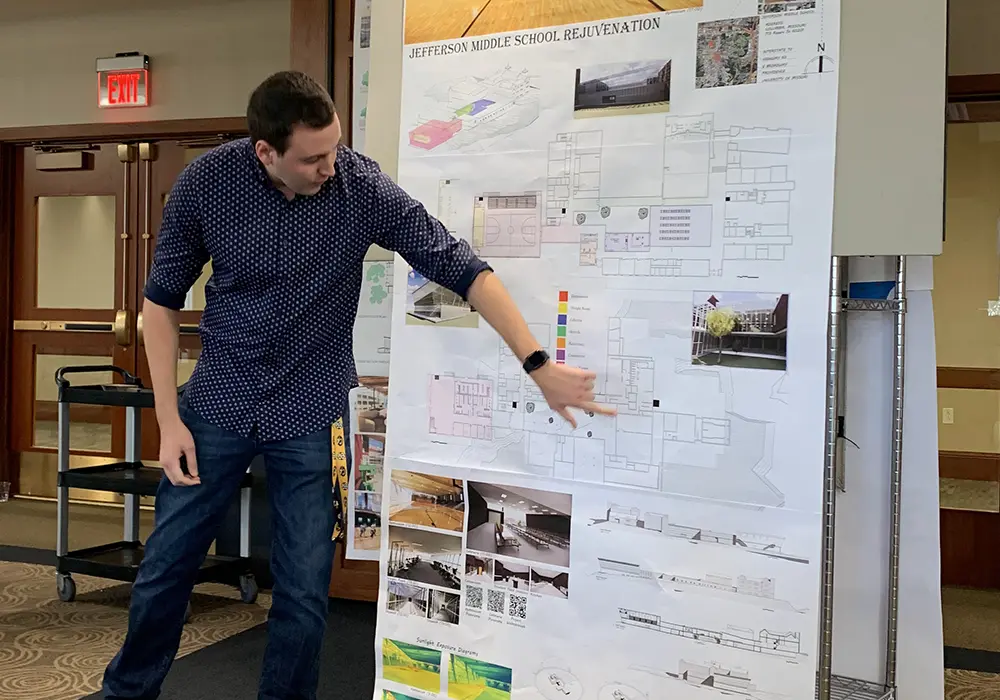
Students have chosen a path to engage with a broader audience. With an architectural studies emphasis, students learn how to zoom out to design comprehensive projects that address entire buildings – through new construction or assessment and retrofit of existing structures. This approach exposes students to responsible design, by considering the context of a project within the surrounding community – its purpose, site adjacent buildings and materials, history, and human and environmental impact. The learning experience continues outside the classroom, with participation in competitions and working on projects for Habitat for Humanity, along with other service learning opportunities.
Students are engaging in:
- Competitions
- Comprehensive projects
- Undergraduate research
- Service learning
Mastery
Phase IV
Integrating all aspects
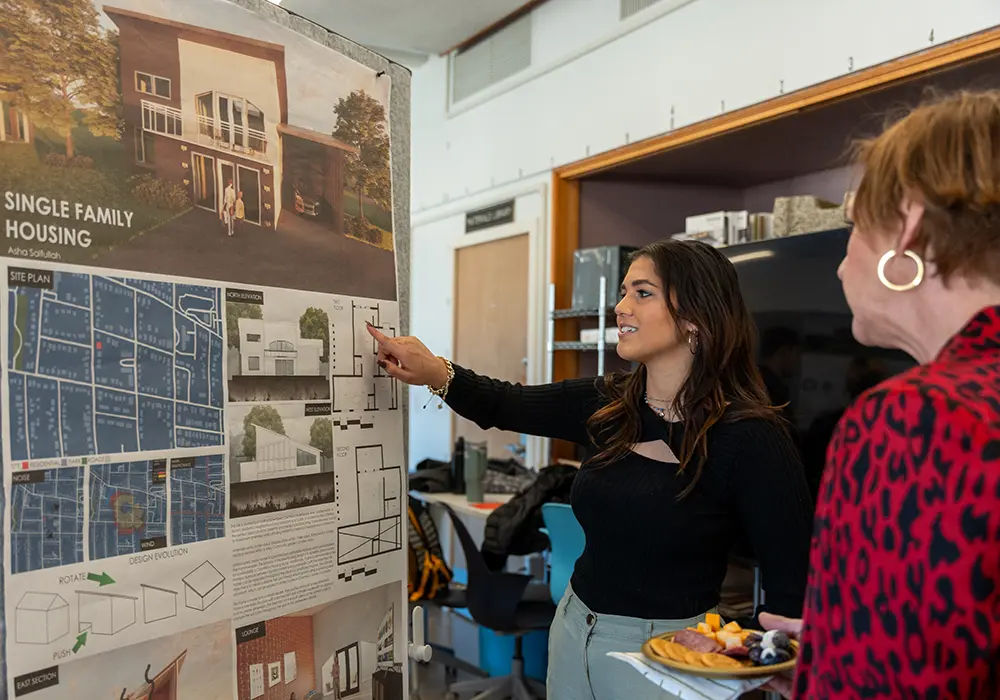
Students continue to evolve their project processes into a realistic representation of the professional practice. They’re polishing their individual skills and gaining creative confidence in their own personal approach to the design process. At this stage, students learn how to pull it all together by applying all they’ve learned to this point by translating the creative design into ready to build construction documents and communicating the vision to those tasked with building it.
This approach exposes students to real constraints of a project – from budget to sourcing, while working through the final steps of the process for construction, documentation, and project delivery, including consideration of the rules, regulations, codes, and zoning of the municipality where the project is being built.
Students are mastering:
- Project parameters
- Sourcing
- Construction requirements
- Divergent and convergent thinking
- Community responsibility
- Efficient processes
- Communication

Careers
Graduate with confidence
Businesses and institutions actively recruit our students because they have more advanced experience and knowledge with digital media and sustainable design practices. They’re ready right from the start to make a more substantial impact on their professional and academic teams. That makes you more marketable.
Requirements
Admission into our professional studio sequence requires an application including:
- Portfolio of work
- Must include creative projects and technical drawing work.
- Attention to craftsmanship and detail is critical.
- Minimum Cumulative GPA of 2.75
- Self Reflection
To continue progress towards the degree and ensure optimal performance, students have a Mandatory Portfolio Submission in May each year for review by faculty.